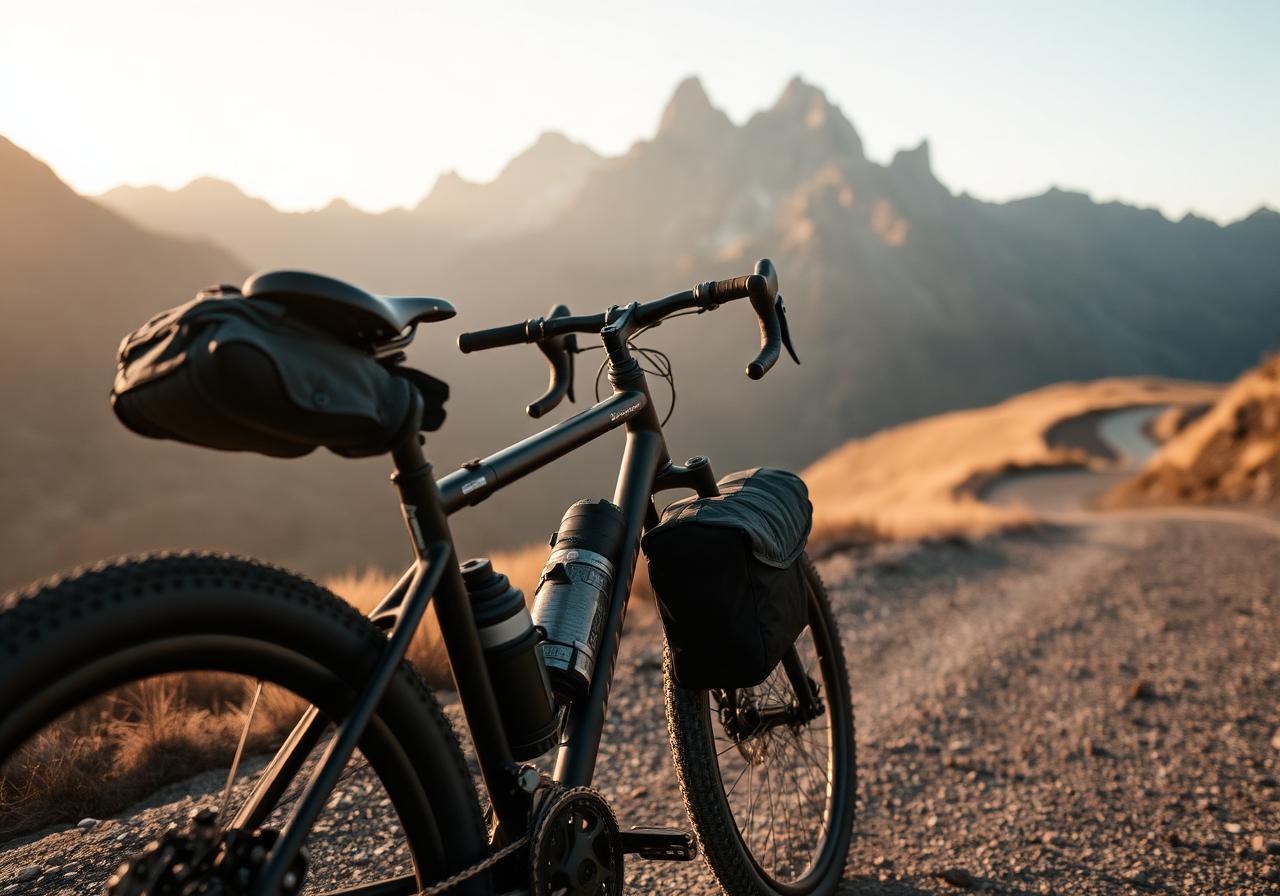
Loading the Bike for Three Weeks Across the Pyrenees
- Tested
- 1,420 km · 28,000m elevation · 22 days
- Logged
- Atlantic to Mediterranean — HRP gravel variant
Quick Verdict
A loaded bike is a different machine, not the same machine plus weight. Get the distribution right — heavy and central in the frame, light and compressible at the extremities — and a fully loaded gravel bike disappears beneath you. Get it wrong and the Pyrenees will tell you, on every descent.
The first thing you notice, leaving the trailhead with three weeks of gear on the bike, is not the weight. It's the silence. The bike absorbs the road differently — it's slower to respond, slower to accelerate, slower to stop. The handling is still familiar but the margin for error is narrower. Every movement costs slightly more than it did yesterday on the empty bike.
The second thing you notice, about two hours in, is that you've been riding wrong for a week in your head. You'd been imagining the loaded bike as the unloaded bike plus weight — the same machine, just heavier. It isn't. It's a different machine that requires different inputs, different line choices, and a different relationship with momentum. The sooner you accept that, the better you ride it.
I did the Pyrenean traverse over 22 days in two stages — the HRP (Haute Route Pyrénées) gravel variant from the Atlantic coast to the Mediterranean, with a secondary loop through the Spanish side. Total distance: 1,420 km. Total elevation: approximately 28,000m. Total system weight at departure: 103 kg. That's me, the bike, and everything I was carrying for three weeks across terrain that ranged from hardpack fire roads to technical mountain passes.
This is what I learned about loading the bike.
The weight distribution problem
Most bikepacking guides focus on total weight. How much kit, how light, what to cut. This matters — but it's secondary to where that weight lives on the bike. The same 12kg of gear distributed badly will make a bike handle like a shopping trolley. Distributed correctly, it becomes almost imperceptible to the handling.
The physics are not complicated. A bike's handling geometry is designed around a specific weight distribution and centre of gravity. Load the rear heavily, lower the rear and raise the effective pivot point, and the front wheel lightens — it steers nervously, wanders, lifts on steep climbs. Load the front heavily and the bike ploughs into corners, resists steering changes, and feels like it's always running slightly ahead of your intentions. The bike is not broken in either case. It's just loaded wrong.
The principle I worked out over time, and tested across 1,400 km: weight belongs as low and as central as possible. Every kilogram that sits high on the bike (above the axle height) and away from the centre (fore or aft of the bottom bracket) multiplies its effect on handling by more than its mass suggests. A 2kg tent strapped high on the handlebar moves the effective weight of the setup more than a 4kg sleeping bag compressed into a low-slung frame bag.
This sounds abstract. In practice, it determines every bag choice you make.
The bag system I ran
I've tried most configurations over several trips. The setup I arrived at for the Pyrenees was the result of deliberate choices about where each weight category belongs on the bike. Not what's fashionable, not what the gear brands suggest — what physics and 22 days of riding across mountain terrain confirmed.
Frame bag — the anchor. The frame bag is the most valuable real estate on a loaded gravel bike. It sits within the frame triangle — the closest position to the bike's centre of gravity. Weight here has the least effect on handling of any location on the bike. I ran a full-frame bag (Apidura Racing Frame Pack, 4.5L on a medium frame) carrying the heaviest items that could tolerate the position: tools and spares, the bear canister with four days of food, a water filter, and the battery pack for electronics. Total in the frame bag: approximately 2.8 kg.
The frame bag has one limitation: it competes with the water bottle. On technical mountain terrain, you need bottle access while riding. The solution is a short bottle cage on the downtube below the frame bag, accessible without dismounting. Accept that it's awkward on some bikes — the alternative is bonking on a 2,000m col because you couldn't reach a bottle without stopping.
Seat pack — volume, not weight. The seat pack carries the sleeping system and most of the clothing — the items with the best weight-to-volume ratio. I ran the Apidura Expedition Saddle Pack (17L) on the Pyrenees trip. Sleeping bag, two base layers, one insulating layer, waterproof jacket and trousers, spare socks and gloves, emergency bivouac layer. Compressed total: approximately 3.4 kg.
The seat pack is the most controversial position on the bike. It sits behind the rear axle, which is the worst location for handling. Two things mitigate this: keeping it as light as possible relative to its size (sleeping systems are ideal because they're light and compressible), and mounting it as low as possible to keep the weight close to axle height rather than sitting high above the wheel.
Handlebar bag — the compromise. The handlebar bag is the position with the worst weight-to-handling trade-off on a gravel bike. Weight at the front and high — exactly what you don't want for steering precision on technical terrain. On the Pyrenean terrain I was covering — loose descents, technical mountain passes, narrow tracks with exposure — a large handlebar roll was not viable. I ran a small harness setup (Apidura Backcountry Handlebar Pack, 9L) carrying only: tent or shelter, sleeping mat, and one day's non-perishable food. Total: approximately 2.2 kg.
What I refuse to carry in the handlebar bag: heavy items. Anything dense — tools, batteries, canned food, water — belongs in the frame bag or, as a last resort, the jersey pockets. Handlebar bag density is the single most common loading mistake I see on loaded gravel bikes in the mountains.
Top tube bag and jersey pockets carry the access items: phone, wallet, snacks for the hour, sunscreen, the day's map screenshot. Light enough that their position doesn't register on the handling — heavy enough, if you load them wrong, to shift the bike's balance backwards in a descent position at exactly the moment you need it stable.
What the terrain did to the loading philosophy
The Pyrenees is not one terrain. It's five or six terrains stacked on top of each other across 430 km, east to west. The Atlantic side — País Vasco and Navarra — is green, wet, grassy, with loose tracks and sharp climbs. The central Pyrenees — Aragon, the high passes — is rocky, exposed, technical, with sustained elevation. The Catalan east is drier, faster, more predictable. Each section asked different things of the loaded bike.
Atlantic section — mud, grip, and the seat pack problem. The Basque gravel is loose and wet. Post-rain tracks in the hills above Pamplona are clay over limestone — exactly the surface that exposes a heavy rear end. On the first three days, I felt the rear wheel push through loose corners in a way I hadn't experienced on the same bike unloaded. Not dangerous, but persistent — a constant reminder that the loaded rear was looking for traction the bike wasn't delivering.
The fix was partly tires (G-One Allround 40mm at 2.0 bar, dropped to 1.8 in the rear on technical sections) and partly line management (weight the outside pedal earlier, stay seated in loose corners rather than standing). Neither solution was ideal. The better solution would have been 2 kg less in the seat pack — which, in retrospect, I had. A lightweight tarp would have done the same job as the tent I was carrying at 600g less. Filed under: decisions made at home that you pay for on the road.
Central Pyrenees — altitude, exposure, and handlebar precision. The high passes are where the handlebar bag makes its presence felt most clearly. Loose descents at altitude, often narrow, sometimes with exposure on one side. The bike needs to be pointed with precision; it doesn't have time for front-end vagueness. The 2.2 kg in the handlebar harness was manageable. I've watched riders with 5–6 kg handlebar rolls fight their bikes through the same sections — the front end wanders, they correct, the correction is late, the process repeats.
Catalan section — speed and the cost of carried weight. By the final week — drier, faster, more road and hardpack — the loading felt like a drag in a different sense. Not a handling problem; a physical one. Every extra kilogram costs roughly 6–8 seconds per kilometre on a sustained 6% climb. Over 28,000m of climbing, the arithmetic is significant. Every item I'd carried for three weeks without using was a toll paid on every ascent.
How weight affects the tires
A loaded gravel bike changes the pressure calculation significantly. The same 40mm tire at the same pressure that works perfectly unloaded can wallow, deform, and lose precision under full bikepacking weight. The key variable is sidewall flex. Under load, the tire's sidewalls compress more with each rotation, which increases rolling resistance and reduces cornering precision. The compensation is higher pressure — but not so high that you lose the compliance that gravel riding requires.
For the Pyrenees at 103 kg total system weight on 40mm tubeless tires: unloaded baseline was front 28 psi, rear 31 psi. Loaded touring pressure was front 33 psi, rear 38 psi. Technical descent pressure was front 31 psi, rear 35 psi — reduced for grip, still above the wallowing threshold.
The casing also matters more under load than most riders account for. I ran the MicroSkin version of the G-One Allround specifically because the reinforced casing stays composed under weight. On the Atlantic clay sections, I watched a rider on ultra-light race-casing tires make choices at corners that I didn't have to make — she was managing the tire, not the terrain.
The cuts that were worth making
Loading a bike for a long trip is an editing process as much as a packing one. The temptation is always to add contingency. Contingency has real value. But it has a cost that compounds across 1,400 km of mountain terrain.
Shelter: tent to tarp, saved 620g. On 18 of 22 nights the weather was appropriate for a tarp. The other four I bivouacked under overhangs or slept in refugios. I was not comfortable on every one of those nights. I was also 620g lighter for 22 days.
Cooking system: cut entirely. The Pyrenees has cafes, supermarkets, and bakeries at sufficient density. The stove and pot I usually carry weigh 380g and would have been used twice. Cold soaking oats is not romantic but it is functional.
First aid kit: ruthlessly edited. Blister prevention, wound closure strips, two painkillers, anti-diarrheal, one bandage — 80g total. The full kit I'd packed initially weighed 280g and contained items for injuries that would have required evacuation regardless.
Spare tire: removed. Carried two tubes and a robust plug kit instead. On a route with reliable bike shop access in the valley towns, a full spare is 250–400g of insurance against a scenario tubes and plugs handle for most failures. Total cuts from initial pack list: ~1.8 kg.
What a loaded bike teaches you about riding
After three weeks on a fully loaded gravel bike across the Pyrenees, the unloaded bike feels like a toy. It's not — it's the same bike. But the standards the loaded bike imposes are exacting: better line choice, smoother braking inputs, earlier corner entry, more patient descents.
Loaded bikepacking makes you a more deliberate rider. You can't throw the bike into a corner and trust momentum. You can't brake hard at the last moment and expect the weight to stop cleanly. You can't power over rough sections and absorb the consequences through your arms alone — there's too much mass and not enough suspension.
What you can do is read terrain earlier, choose your line further ahead, ride within the bike's loaded handling envelope with enough margin that nothing surprises you. That's a skill. It transfers back to the unloaded bike in the form of patience and precision — the two things that distinguish riders who consistently go fast from riders who occasionally go fast.
"The Pyrenees is the right terrain to learn it on. It asks something of you on almost every stage. You're present for the full 22 days."
Verdict
Three weeks across the Pyrenees with a properly loaded gravel bike is not a test of fitness — it's a test of editing. Edit the kit, edit the bag positions, edit the lines you ride. The bike rewards every gram you put in the right place and punishes every gram you put in the wrong one. Get the distribution right and a 10 kg load becomes a partner. Get it wrong and it becomes the route's hardest climb.
- Best for
- Experienced riders planning long mountain traverses with technical terrain
- Skip if
- You're new to both touring and off-road riding — start with a flatter, more serviced route first
FAQ: Schwalbe G-One Allround
How much should a bikepacking setup weigh?
For a multi-week trip on mixed terrain, aim for 8–12 kg of carried gear including water. Below 8 kg is possible with discipline and the right route; above 12 kg starts to affect handling and climbing performance noticeably. Total system weight (rider + bike + kit) above 110 kg warrants a reinforced casing and higher tire pressure.
Where should the heaviest items go on a bikepacking setup?
As low and as central as possible — inside the frame triangle. The frame bag position has the least effect on handling of any location on the bike. Dense, heavy items (tools, batteries, water, food) belong in the frame bag. Light, compressible items (sleeping bag, clothing) belong in the seat pack and handlebar roll.
What is the best bag system for a gravel bike bikepacking setup?
Frame bag + seat pack + small handlebar roll is the most practically versatile configuration for technical mixed-terrain routes. The frame bag anchors heavy items centrally; the seat pack carries volume efficiently; the small handlebar roll keeps the front end manageable on technical descents. Avoid large handlebar rolls (above 10L) on routes with sustained technical terrain.
How do I stop a loaded bike from handling badly?
The two main causes of poor loaded handling are: weight too far rearward (heavy seat pack, nothing in the frame) and weight too high (dense items in a tall handlebar roll). Move heavy items to the frame bag, use a lower-mounted seat pack, and keep the handlebar roll as light as possible. Also check tire pressure — running too low under load causes wallowing; running too high loses grip.
What tires should I use for a loaded bikepacking trip?
A reinforced casing in 40–45mm tubeless — the Schwalbe G-One Allround MicroSkin, Teravail Rampart Durable, or Schwalbe G-One Overland Pro for heavier setups. The reinforced casing stays composed under load and resists sidewall cuts on rough terrain. Ultra-light race casings are not appropriate for loaded touring.
How does loading the bike affect tire pressure?
Significantly. Full bikepacking load (10–15 kg of kit) requires adding 5–8 psi to your unloaded baseline pressure, with a larger adjustment on the rear than the front. Running unloaded pressures under full load causes the sidewalls to deform excessively, increasing rolling resistance and reducing cornering precision.
Is the Pyrenees a good first bikepacking route?
No — and yes. The terrain is demanding, the navigation requires attention, and the weather on the Atlantic side is unpredictable. For riders with touring experience but new to loaded off-road riding, it's a significant but manageable challenge. For riders new to both, start with a flatter, more serviced route first.
Author
Guillaume Faure
Guillaume has ridden gravel routes across 12 European countries since 2018. He founded Gravel Tread to publish the kind of tire reviews he wished existed when he was choosing his first set.
Related Reviews