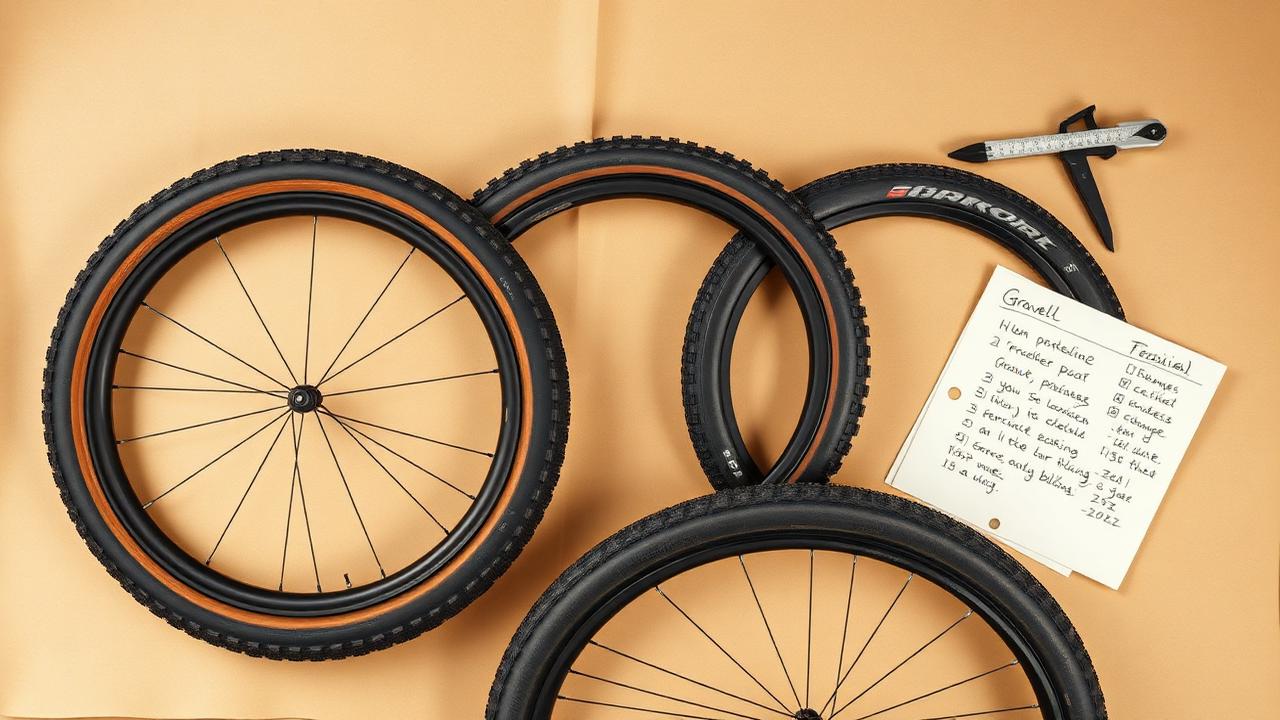
The Short Answer
Gives you a repeatable process for choosing a gravel tire based on your actual riding, not a generic ranked list. Answer the four questions below, combine the answers using the table at the end, and you'll arrive at a specific shortlist — not "it depends."
Most tire guides give you a list. This one gives you a process.
The difference matters because there is no universally best gravel tire. A tire that's outstanding on wet Iberian clay is mediocre on hardpack Alpine gravel. A tire that rolls efficiently on mixed surfaces is wrong for a loaded three-week expedition on rough terrain. The right answer depends on four variables specific to your route and how you ride — and a ranked product list can't account for any of them.
The four questions below do. Work through them in order. Answer honestly — not based on what you want to be riding, but on what your route actually requires.
Question 1: What is your terrain split?
Think about a typical riding day on your planned route. Roughly what percentage of time will you spend on each surface type? Be specific. If you're planning a route, look at the GPX data or map — most route-planning tools give surface type breakdowns. If you're choosing a tire for general use, think about the last three or four rides you did.
| Option | Terrain | Target |
|---|---|---|
| A | Road-heavy (>50% tarmac or hardpack) | 35–38mm, low-profile or semi-slick centre tread, harder compound |
| B | Mixed (30–70% unpaved, rest tarmac) | 38–42mm, balanced centre and shoulder tread, medium compound |
| C | Gravel-heavy (>70% unpaved, varied surface) | 40–45mm, pronounced shoulder knobs, medium-soft compound |
| D | Off-road dominant (singletrack, technical) | 45–50mm, aggressive tread with tall shoulder knobs, soft compound |
On Option C you can sacrifice road efficiency for tread and grip. The occasional tarmac connection is manageable on a more aggressive tire; the reverse — a fast-rolling tire on sustained technical gravel — is more uncomfortable. Option D is at the edge of what a gravel tire is designed for; a standard all-round tire will manage but will ask more of your skill and line management than a dedicated off-road tire.
Question 2: What conditions will you ride in?
Be honest about likely conditions, not ideal ones. A route planned in August in Portugal can become very wet. A trail mapped as packed gravel may be loose clay after three days of rain. Plan for the worst day on your route, not the best.
| Option | Conditions | Implication |
|---|---|---|
| A | Dry and warm | Standard mid-hardness compound. Prioritise rolling efficiency. |
| B | Mixed — some wet sections likely | Compound that grips when cold; shoulder knobs that engage in damp corners. Most mid-range 40mm TLR tires fit. |
| C | Consistently wet or cold (below 10°C) | Soft compound, taller shoulder knobs, more open tread spacing. Compound matters more than pattern here. |
| D | Unknown or highly variable | Go grippier rather than faster. All-round tire at the grippier end of the spectrum. |
Question 3: How much will you carry?
Load changes how a tire behaves. A light, supple high-TPI casing that rides well unloaded can become vague and wallowy under full bikepacking weight. Sidewalls flex more under load, reducing cornering precision and increasing the risk of bead burps at the lower pressures gravel riding requires.
| Option | Load | Implication |
|---|---|---|
| A | Day rides or light kit (under 5kg) | Almost any tire handles this. Prioritise rolling speed and suppleness. 120 TPI is appropriate. |
| B | Loaded touring or bikepacking (5–15kg) | Reinforced casing (MicroSkin, Teravail Durable). 40–45mm. Avoid ultra-light race casings. |
| C | Expedition or heavy touring (15kg+) | Reinforced casing mandatory. 45mm minimum. Run 5–8 psi higher than unloaded. G-One Overland Pro and WTB Resolute are built for this. |
Question 4: What is your primary priority?
You cannot optimise a tire for everything. Every design choice is a trade-off. Be clear about which trade-off you're willing to make — many riders choose an answer here that doesn't actually match how they ride.
| Priority | Trade-off | Prioritise |
|---|---|---|
| Speed first | Reduced grip on technical sections | Low rolling resistance, semi-slick centre tread, harder compound, 35–38mm |
| Grip first | Slower road sections, more weight | Softer compound, taller shoulder knobs, open tread, 40–45mm |
| Durability first | Extra weight and rolling resistance | Reinforced casing, high puncture rating, proven mileage, 40–45mm |
| Versatility first | Won't lead any single metric | 40mm all-round category. The Schwalbe G-One Allround is the clearest expression. |
Combining your answers
Use this table to find your starting point. Then verify against the terrain guide and tire directory to confirm.
| Terrain | Conditions | Load | Priority | Starting point |
|---|---|---|---|---|
| A (road-heavy) | A | A | Speed | 35–38mm semi-slick (GravelKing Slick, G-One Speed) |
| A (road-heavy) | A or B | A | Versatility | 38–40mm all-round (G-One Allround, Sparwood) |
| B (mixed) | A or B | A | Any | 40mm all-round — the default answer |
| B (mixed) | C or D | A or B | Grip | 40mm grippy (Continental Terra Trail, G-One Ultrabite 40mm) |
| B (mixed) | Any | B | Durability | 40mm reinforced (G-One Allround MicroSkin, Teravail Rampart Durable) |
| B (mixed) | Any | C | Durability | 45mm heavy-duty (G-One Overland Pro, WTB Resolute) |
| C (gravel-heavy) | A or B | A | Any | 40–42mm performance (Maxxis Rambler, Rene Herse Snoqualmie) |
| C (gravel-heavy) | C or D | Any | Grip | 42–45mm grippy (WTB Resolute, Schwalbe G-One Ultrabite) |
| C (gravel-heavy) | Any | B or C | Durability | 42–45mm reinforced (WTB Resolute, Teravail Rampart Durable) |
| D (off-road) | Any | Any | Grip | 45–50mm aggressive (G-One Ultrabite 45mm, WTB Riddler 45mm) |
The one-sentence version
Pick the narrowest, smoothest tire you would trust on the hardest section of your route.
That sentence earns its keep. It prevents over-speccing — a 45mm knobby is unnecessary and slow on a mixed-terrain route with one technical descent. It also prevents under-speccing — a semi-slick will fail you when the terrain requires more. The hardest section of your route sets the floor. Your terrain split determines the ceiling. Find the tire that lives between them.
Two worked examples
Example 1: Long-distance bikepacking, Pyrenees traverse
- Terrain: B — approximately 60% unpaved, 40% road and hardpack
- Conditions: B/C — variable, some wet and cold sections in altitude
- Load: B — full bikepacking kit, approximately 10kg
- Priority: Durability — remote route, limited resupply
Framework result: Row B/C, load B, durability → 40mm reinforced casing.
Recommendation: Schwalbe G-One Allround 40mm MicroSkin, or Teravail Rampart 38mm Durable. The MicroSkin wins on versatility across the full terrain range; the Rampart wins if the route has consistent technical sections.
Example 2: Day rides, local mixed gravel, no load
- Terrain: B — 50/50 road and gravel
- Conditions: A/B — mostly dry, occasional wet
- Load: A — day ride, no kit
- Priority: Versatility — don't want to think about it
Framework result: Row B, load A, versatility → 40mm all-round.
Recommendation: Schwalbe G-One Allround 40mm, Panaracer GravelKing SK 40mm, or Teravail Sparwood 38mm depending on budget and availability. All three are correct answers for this situation.
FAQ: Gravel Tubeless Setup
What is the best all-round gravel tire?
For mixed terrain riding, the Schwalbe G-One Allround 40mm is the most consistently recommended tire for a reason — it handles the widest range of conditions without demanding a terrain commitment. It is not the fastest, grippiest, or most durable option, but it handles everything adequately and sets up tubeless reliably.
How do I know what width gravel tire to choose?
Start with 40mm unless you have a specific reason to go narrower or wider. Go narrower (35–38mm) if your routes are road-heavy or speed is the priority. Go wider (42–45mm) if you're carrying significant load or riding technical terrain. Always verify your frame's actual clearance before buying.
Should I choose tubeless or clincher for gravel?
Tubeless. For gravel riding, tubeless allows 5–10 psi lower pressure — improving grip and comfort on rough terrain — and seals small punctures automatically. The setup process is straightforward with compatible components.
Is a more expensive gravel tire worth it?
Generally, yes — up to a point. The jump from a cheap clincher to a quality 120 TPI tubeless tire is very significant. The jump from a €55 all-round tire to a €90 premium tire is more nuanced and depends on whether the premium addresses your specific riding needs. For touring and bikepacking, spend on casing quality and puncture protection, not brand name.
How do I choose between two similar tires?
Use the framework above to confirm both are appropriate for your terrain, conditions, and load. If both pass, choose based on: (1) which addresses the hardest section of your route better, (2) availability and price in your region, and (3) any personal experience or strong independent reviews of either tire in your specific conditions.
Can I use the same gravel tire year-round?
Yes, with caveats. A 40mm all-round tire with a medium compound handles most year-round conditions. In consistently wet winter conditions, you may want to switch to a grippier, softer compound — the Continental Terra Trail or Schwalbe G-One Ultrabite. Running a fast-rolling summer tire in cold, wet winter conditions is the most common gravel tire mistake.